Explorer and Independent Biologist

Thursday, 10 February 2011

Catkins

Hazel catkins in late winter sunshine
at Roudsea Woods and Mosses National Nature Reserve

Monday, 31 January 2011

Imbolc, Askam and Badger

Imbolc is the festival that falls half-way between the Winter Solstice (Yule) and the Spring Equinox (Ostara). Imbolc has existed for centuries until it was renamed Candlemas by the Christians. Traditionally it is celebrated on 1-2 February but, as usual with these festivals, nobody minds if the celebrations are extended a few days on either side.

Imbolc is not Spring, but it may be the herald of Spring. We may expect to see the first catkins dangling in thin sunshine, and the first snowdrops in bloom. 

Above all, it marks a noticeable lengthening of the daylight, the time when thoughts turn to cleaning agricultural tools, sewing early seeds and checking if the pregnant ewes are safely through the worst of winter.

This year I was honoured to have my Australian 
friend and fellow blogger Badger*
(who presently lives in Vienna)
visit me in Maalie Court, Askam-in-Furness,
to share the Imbolc Festivities.

One of our Imbolc celebratory suppers.
Badger is speechless with amazement that an Englishman
can cook such an appetising looking pike pie


The foreshore of Askam-in-Furness is dominated by
salt marsh, where boats are hauled up 
into the creeks for the winter;
Or simply left to die.


Badger takes a stroll around the salt-marsh...


 ...and takes some 'arty-farty' pictures
of decaying boats


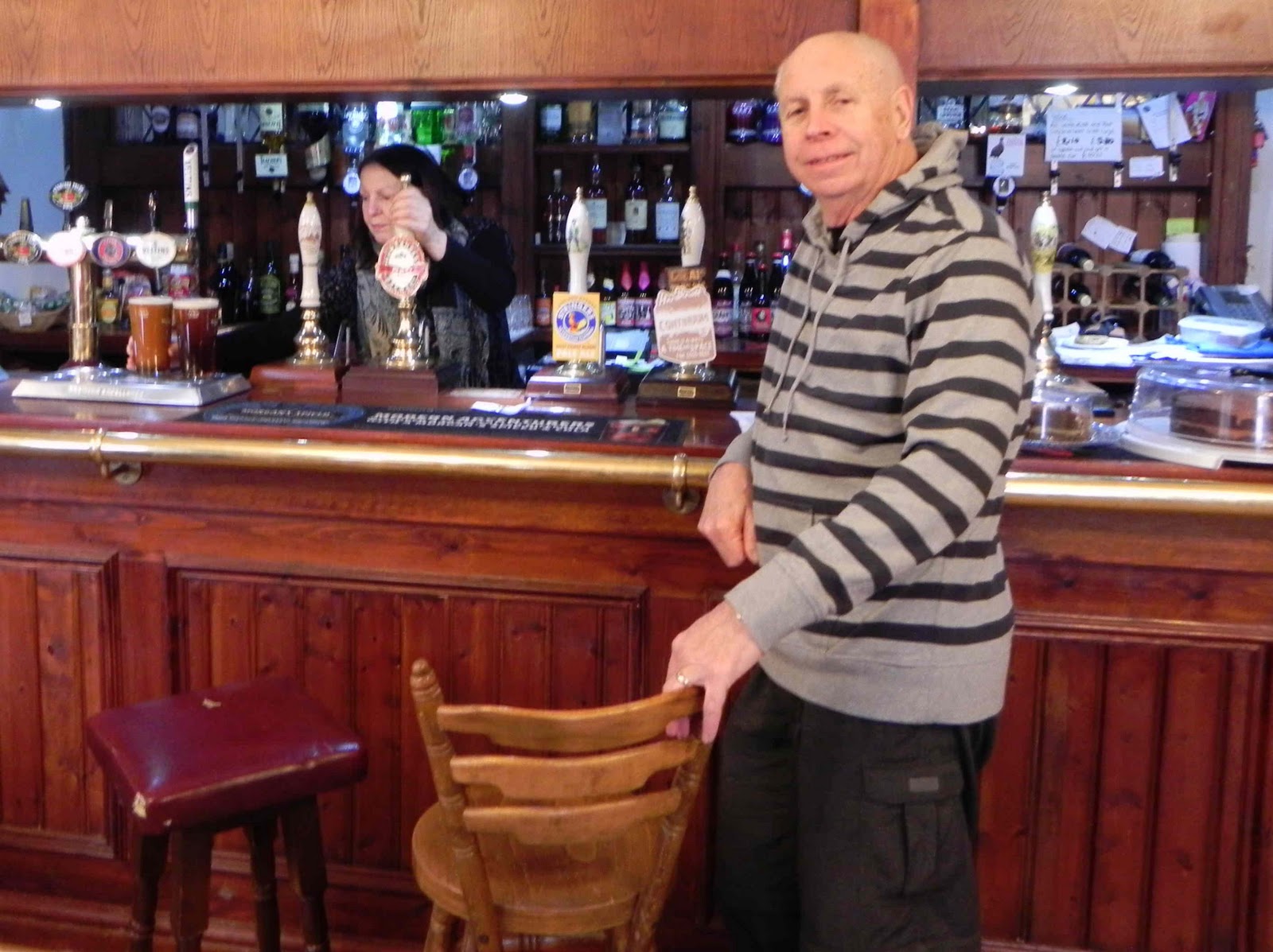
 Badger steers us into the Queens Arms pub
for an Imbolc pint of Cumbria Ale.
Or was it two?


I find the first Snowdrops of the year in to time
to mark the Festival of Imbolc

A Very Happy Imbolc
to all my Readers
You may light any candle stubs left over from Yuletide 
to keep the Ghosties away

*You may discover more about Badger and his blog here

Friday, 21 January 2011

The Piel Triangle

The stretch of water between Walney Island and the Furness Peninsula of the Cumbria Mainland is subject to fast-flowing tidal currents as the huge volume of water from Morecambe Bay surges through it during the flood and ebb tides. There is one particular area at the mouth of the channel, known as the Piel Triangle, where the currents and tide rips can be particularly ferocious during the highest tides and is referred to by some locals as the Devil's Cauldron.

Morecambe bay and the Furness Peninsula showing the location of the 
Piel Triangle at the mouth of the Walney Channel


The dreaded Piel Triangle lies at the mouth of the Walney Channel 
and encloses the water between three islands. 


 Piel Island from Foulney Island. 
The channel looks benign enough at low tide. 
Piel Castle (at the left end) was built in 1212 when King John allowed 
the monks to store provisions there (including gunpowder, it is said).

 
Roa Island from Foulney Island. 
The lifeboat station is testimony to the 
reputation of the Piel Triangle. 
Coastguard cottages catch the afternoon winter sunlight. 

During a fine settled (though cold) period of weather I
was tempted to paddle out into the Piel Triangle in my FeelFree Nomad Kayak 
and pit my skills against whatever the dreaded Cauldron could throw at me.

Ready to launch from the slipway on Roa Island

Venturing out into the centre of the Piel Triangle, 
the sea seems calm enough during slack water at high tide.

Nudging closer to a channel marker buoy, 
with Piel Castle in the background, 
the ebb flow started almost without warning.
I found myself having to paddle vigorously to make small headway


Eventually I found refuge in the stiller backwater 
towards the old coastguard station 
and coastguard cottages on Roa island


Wednesday, 19 January 2011

Vaga Luna - Lovely Moon

Collared Dove Streptopelia decaocto and moon
Illmitz, Burgenland
At the Summer Solstice 2010


Click on the arrow to hear Cecilia Bartoli singing Vaga Luna by Bellini

Vaga luna, che inargenti
queste rive e questi fiori
ed inspiri agli elementi
il linguaggio dell'amor;
testimonio or sei tu sola
del mio fervido desir,
ed a lei che m'innamora
conta i palpiti e i sospir.
 
Lovely moon, you who shed silver light
On these shores and on these flowers
And breathe the language
Of love to the elements,
You are now the sole witness
Of my ardent longing,
And can recount my throbs and sighs
To her who fills me with love.

Sunday, 2 January 2011

Mereside Chronicle

A tribute to Charles F Tunnicliffe (1901 - 1979)

When I was a very small Maalie, my sister gave me a book that had a life-changing influence on me: Mereside Chronicle by C F Tunnicliffe, naturalist and artist. His book records his observations and sketches through the year at various meres and water bodies around his home near Macclesfield, Cheshire.

Even at the tender age at which I read the book, its impact was to impress on me the discipline of making regular observations, and recording them. The book was published in 1948 and therefore the pictures show scenes as they existed at least 63 years ago. My aim on this rather misty-murky New Year's Eve was to try to locate and photograph some of the scenes depicted by Tunnicliffe.

Capesthorne Pools 
Capethorne Pools are old fish ponds associated with Capesthorne Hall


There can be no doubt about which tree Tunnicliffe was depicting in his drawing (above): although the tree has grown thicker in the ensuing 65 years, the individual branches can be recognised.


The arches of the bridge across these old fish ponds appear through the fog

My sister Jill sits on the parapet of the bridge 
once again holding the book she gave me so many years ago

Redesmere
 Redesmere is a reservoir that was clearly one of Tunnicliffe's favourite places. Unfortunately the foggy whether did not permit some of the scenic views but nevertheless some features were clearly recognisable.


The road has been widened and a car park constructed, but the Henbury Road leading down to Redesmere 
can be recognised from Tunnicliffe's drawing

Despite the fog concealing the mere, Tunnicliffe's white railings remain.
However the un-eroded state of the concrete posts 
suggest the fence has been replaced

 Further along we find an old dilapidated, eroded  section of fence 
which no doubt dates back to Tunnicliffe's era

 Gawsworth Pools
The Gawsworth Pools are old fish ponds associated with Gawsworth Hall. With the church and buildings still present, it was easy to relocate the scenes of Tunnicliffe's sketches
 The growth of vegetation around the church has changed, but the view is clear


 At the Upper Pool the sign has changed and the square building has an extension

North Rode Pool
 North Rode Pool seems to have changed very little since Tunnicliffe's day.
The outlet shaft and white house at the far end of the pool are still present

 To find out more about the life and work of this remarkable birdwatcher and artist, 
you can visit the website of the Charles Tunnicliffe Society

Saturday, 25 December 2010

A Merry kayaking Christmas!

Christmas Eve in Cumbria was so fine and sunny I launched my kayak near Bootle on the west coast of Cumbria. With a light northerly and  gentle swell, launching from the stony beach was not difficult.

I paddled out to the pole mark you can see near the horizon 
and moored there for a while fishing. No luck though.

With the midday sunshine shining brightly it was almost warm! 
Black Combe has a snowy mantle.
Sorry about the wonky horizon, the boat was actually tossing around in the swell

On Christmas morning, some clouds had rolled in and the temperature was -10.5 C. I was on Coniston Water by 8.00am, with Venus still shining brightly!

Boats moored on Coniston Water emerge eerily from the dawn mist 
on Christmas morning

The sun rises behind the mountains and drives off the mist


 Like an explorer sailing towards the Pole, I eventually encounter the pack ice. 
Without a strengthened hull I was reluctant to penetrate the ice - 
I did not want to risk becoming a "Coniston Shackleton" 
and become ice-bound for the rest of the winter!
 The rising sun illuminates the slopes of the Old Man of Coniston

 With my fishing rod already iced up, and my toesies freezled, 
I pull ashore for my Christmas breakfast.

And I assure you there is something a little more appropriate 
than tea in the glog mug ;-)

Monday, 20 December 2010

Solstice eclipse and Arctic birds

A very Happy Winter Solstice to all my readers!
In Britain we are experiencing a particularly cold period with day-time temperatures staying well below zero. The cold weather is pushing a number of Arctic migrant birds south and west into Europe and for the first time in 400 years there is a Solstice total eclipse of the moon in Britain.

 I am up and out in time to greet the Solstice dawn over my village

For the first time in 400 years, the Winter Solstice sees a total eclipse of the moon 
in Britain. The Earth's shadow is crossing the moon prior to totality, just before sunrise

 At total eclipse the moon takes on a coppery hue, 
but is already setting in the haze of the horizon

Ice floes on the River Leven estuary - the first time I have seen 
the sea freeze over since I have been living in Cumbria

A Redwing seeks out the few remaining haw-berries
(The bold eye-stripe distinguishes it from other thrush species)

A Fieldfare, possibly south from Lapland

A pair of Fieldfares seek warmth in the weak Solstice sunshine
A Waxwing from Bohemia (or further north and east)

 
The Waxwing secures a nutritious haw-berry in its bill

From today, the sun commences its sojourn back to the Northern Hemisphere. 
I wish you joy in anticipation of warmer, brighter days to come.